
News
Forsyth County Senior Tax Exemptions: What Homeowners 62 and Older Can Claim in 2026
Forsyth County homeowners who are 65 or older on January 1 can remove the school portion of their property tax bill through the county’s L1 exemption, which carries no income limit, while homeowners 62 and older whose household income falls under specific thresholds can qualify for additional school tax relief.
Georgia’s income tax rules strengthen that position for residents in or near retirement, because the state does not tax Social Security benefits, applies a flat 4.99% rate for 2026 and allows each taxpayer 65 or older to exclude up to $65,000 of retirement income from state taxable income.
Whether you are relocating to metro Atlanta from another state or have lived in Forsyth County for decades and are approaching your sixties, the sections below explain each senior exemption the county offers, the January 1 ownership rule that determines when a new homeowner can claim it and the Georgia income tax changes that took effect under House Bill 463 in 2026.
Key Takeaways:
- Forsyth County homeowners who are 65 or older on January 1 qualify for a full exemption from school general and school bond taxes on their primary residence, with no income limit.
- Homeowners 65 and older with a combined gross household income of $40,000 or less can also claim a double homestead exemption of $16,000 against county taxes.
- Applications must be received by April 1 to apply to that year’s tax bill, and the homeowner must own and live in the home as of January 1.
- Georgia’s flat income tax rate is 4.99% for 2026, Social Security benefits are exempt and the retirement income exclusion for taxpayers 65 and older rises from $65,000 to $70,000 per person in 2027.
What Property Tax Exemptions Does Forsyth County Offer Seniors?
Forsyth County offers four senior property tax exemptions, each tied to the homeowner’s age on January 1 and, in three cases, to household income, and all of them are added on top of the regular homestead exemption that any owner occupant can claim.
- Age 65 School Tax Exemption (L1)
- Age on Jan. 1: 65 or older
- Income Limit: None
- What It Reduces: 100% of school general and school bond taxes on the home
- Double Homestead Exemption (S4/L4)
- Age on Jan. 1: 65 or older
- Income Limit: Gross income of applicant and spouse up to $40,000
- What It Reduces: $16,000 off assessed value for county taxes, double the regular $8,000
- State School Tax Exemption (S3)
- Age on Jan. 1: 62 or older
- Income Limit: Net household income of $10,000 or less
- What It Reduces: $10,000 off assessed value for school taxes
- Local School Tax Exemption (L3)
- Age on Jan. 1: 62 or older
- Income Limit: Gross household income of $16,000 or less
- What It Reduces: Full school tax exemption on the home and 3 acres, or $20,000, whichever is greater
Forsyth County Age 65 School Tax Exemption (L1)
The L1 exemption grants a full exemption from the school general and school bond tax categories to Forsyth County homeowners who are 65 or older on or before January 1, regardless of income. Because the exemption is a homestead exemption, it applies only to the home the owner lives in as a primary residence, and the owner must already hold or be applying for the regular homestead exemption to receive it. When a home is titled to two owners, only one owner who occupies the home needs to meet the age requirement.
Forsyth County Double Homestead Exemption for Homeowners 65 and Older (S4/L4)
Homeowners who are 65 or older on January 1 and whose combined gross income from all sources, including a spouse’s income, does not exceed $40,000 can claim a double homestead exemption of $16,000 against county taxes. The county requires income documentation with this application, which must be filed in person.
School Tax Exemptions Based on Income for Homeowners 62 and Older (S3/L3)
Homeowners who are 62 or older on January 1 can reduce or eliminate school taxes before reaching 65 when household income falls below two thresholds. A net household income of $10,000 or less qualifies for the state’s $10,000 school tax exemption, while a gross household income of $16,000 or less qualifies for a local exemption covering school taxes on the home and up to 3 acres, or $20,000 of value, whichever is greater.
How The Regular Forsyth County Homestead Exemption Works
Every Forsyth County homeowner occupant who claims a homestead receives an $8,000 reduction in assessed value for county maintenance and operations and fire taxes, along with a $2,000 state exemption applied to the school and state portions of the bill. Georgia assesses property at 40% of fair market value, so these exemptions reduce the assessed figure on which the millage rate is calculated. The county also applies its floating homestead exemption, approved by voters in 2001, automatically to every homestead exemption it grants, which limits how much the county portion of a homesteaded property’s assessment can rise from year to year. For more information, click here.
Georgia’s Statewide Floating Homestead Exemption Beginning in 2027
Senate Bill 33, which Governor Brian Kemp signed on May 11, 2026, makes Georgia’s statewide floating homestead exemption mandatory for all local governments and school districts beginning with the 2027 tax year. The exemption, first created by House Bill 581, caps annual increases in the assessed value of a homesteaded property at the rate of inflation, and the Forsyth County Board of Education had opted out of it in 2025. Homeowners who want to know how the change will affect the school portion of their 2027 bill can confirm the details with the Forsyth County Board of Assessors.
When is The Deadline to Apply for Forsyth County Senior Tax Exemptions?
Forsyth County homeowners must submit exemption applications by April 1 for the exemption to apply to that year’s property tax bill, and the applicant must own the home, live in it as a primary residence and be a legal resident of the county as of January 1 of the same year. Applications are accepted year-round, so a homeowner who files after April 1 receives the exemption beginning with the following tax year.
How to Apply For The Forsyth County Age 65 School Tax Exemption
Regular homestead, floating homestead and age 65 school tax applications can be submitted online through the county’s SmartFile tool, by mail or in person, while the exemptions based on income, disability and veteran status must be filed in person at the Forsyth County Board of Assessors, located at 426 Canton Highway in Cumming.
The county defines a legal resident as someone registered to vote or registering vehicles in Forsyth County, and applicants generally need a Georgia driver’s license or state ID showing the property address.
Homeowners who already hold a regular homestead exemption must still file a separate application when they turn 65, since the L1 exemption is never added automatically. The Board of Assessors can be reached at 770-781-2106.
When Can Buyers of a New Home in Forsyth County Claim The Homestead Exemption?
Buyers of a new home in Forsyth County can claim the homestead exemption for a given tax year only when they have closed on the home and moved in by January 1 of that year. A buyer who closes and moves in during December 2026 can file by April 1, 2027 and receive the exemption on the 2027 tax bill, whereas a buyer who closes in January 2027 will wait until the 2028 tax year.
Buyers relocating from another Georgia county or another state who held a homestead exemption elsewhere should request a letter confirming that the previous exemption has been removed, because Forsyth County will not grant a homestead while another is active.
Do Forsyth County Senior Exemptions Transfer to a New Home?
Forsyth County renews an approved exemption automatically each year for as long as the owner continues to occupy the home, but a homeowner who buys and moves into a different home, changes the deed or becomes eligible for a larger exemption must submit a new application. Refinancing a mortgage does not affect the exemption unless the names on the deed change.
How Does Georgia Tax Retirement Income in 2026?
Georgia taxes income at a flat 4.99% for 2026, exempts Social Security benefits entirely and lets each taxpayer 62 or older subtract a set amount of retirement income before that rate applies, which means many retired households in Forsyth County owe little or no state income tax.
Georgia’s 2026 Flat Income Tax Rate
Georgia’s personal income tax rate is a flat 4.99% for the 2026 tax year, down from 5.19% in 2025, under House Bill 463, which Governor Kemp signed on May 11, 2026 and which applies retroactively to January 1. Georgia replaced its graduated brackets, which had topped out at 5.75%, with a single rate in 2024, and the new law schedules further reductions of 0.125 percentage point a year beginning in 2027 until the rate reaches 3.99%, provided the state meets revenue conditions set in the law.
Georgia Retirement Income Exclusion by Age
Georgia allows taxpayers aged 62 to 64, along with those under 62 who are permanently and totally disabled, to exclude up to $35,000 of retirement income per person, and taxpayers 65 or older to exclude up to $65,000 per person for 2026. House Bill 463 raises the exclusion for taxpayers 65 and older to $70,000 per person beginning with the 2027 tax year, and that increase carries no revenue condition.
The exclusion covers pensions, annuities, taxable IRA and 401(k) distributions, interest, dividends, capital gains, net rental income and royalties, along with up to $5,000 of earned income. Each spouse’s exclusion applies only to income that spouse receives, so a married couple in which both spouses are 65 can exclude up to $130,000 in 2026 when each holds retirement income in his or her own name.
Georgia Standard Deduction and Dependent Exemption for 2026
Georgia’s standard deduction for 2026 is $15,000 for single, head of household and married filing separately filers and $30,000 for married couples filing jointly, while the exemption for each dependent rose from $4,000 to $5,000. The separate personal exemptions of $2,700 for single filers and $7,400 for joint filers that applied before 2024 were eliminated when Georgia adopted its flat tax and folded that value into the larger standard deduction.
Which Peachtree Residential Communities in Forsyth County Have Homes Available Now?
Peachtree Residential has homes available now in five Forsyth County communities, priced from $599,900 at Hillshire to $1,288,500 at White Post on Lake Lanier, and several of those homes place the owner’s suite on the main level. Each community sits within reach of Cumming City Center, Lake Lanier and GA 400, and every home is built under Peachtree Residential’s Foundation to Rooftop Gold Standard of Approval, which includes a structural engineer’s inspection at each stage of construction.
Hillshire in Cumming: Homes Available From $599,900 to $725,000
Hillshire is a 20-home community at 3310 Hillshire Drive in Cumming, about five minutes from Sawnee Mountain Park and the Sawnee Mountain Preserve and a short drive from the 75-acre Cumming City Center, with its restaurants, trails, Saturday farmers market and 2,000 seat amphitheater. Peachtree Residential offers traditional and modern farmhouse plans at Hillshire with roughly 2,700 to 3,200 square feet of living space.
To schedule a visit, contact the onsite agents or fill out a community interest form via the Hillshire community page.
Arden on Lanier in Cumming: Homes Available From $689,500 to $1,099,000
Arden on Lanier is a 58-homesite community at 4510 Aiden Way, off Pilgrim Mill Road, where homeowners are minutes from swimming and boating on Lake Lanier and can launch a boat at nearby Young Deer Creek Park. Homes offer roughly 2,700 to 4,000 square feet, and residents gather at a community fire pit.
Peachtree Residential’s Arden on Lanier has six quick move-in homes available, all featuring two stories of living space and four or five bedrooms. For more information, visit the Arden on Lanier community page.
Richland Woods in Gainesville: One Home Available at $1,095,900
Richland Woods is a collection of four single family homes on homesites of one acre or more in the Forsyth County portion of Gainesville. Currently, one home is under construction at 8025 Bethel Road, featuring the Chatsworth plan with four bedrooms, four-and-a-half baths, 3,619 square feet and an owner’s suite on the main level, priced at $1,095,900.
Contact the onsite team or schedule your tour by visiting the Richland Woods community page.
The Glade in Cumming: One Home Available at $1,250,000
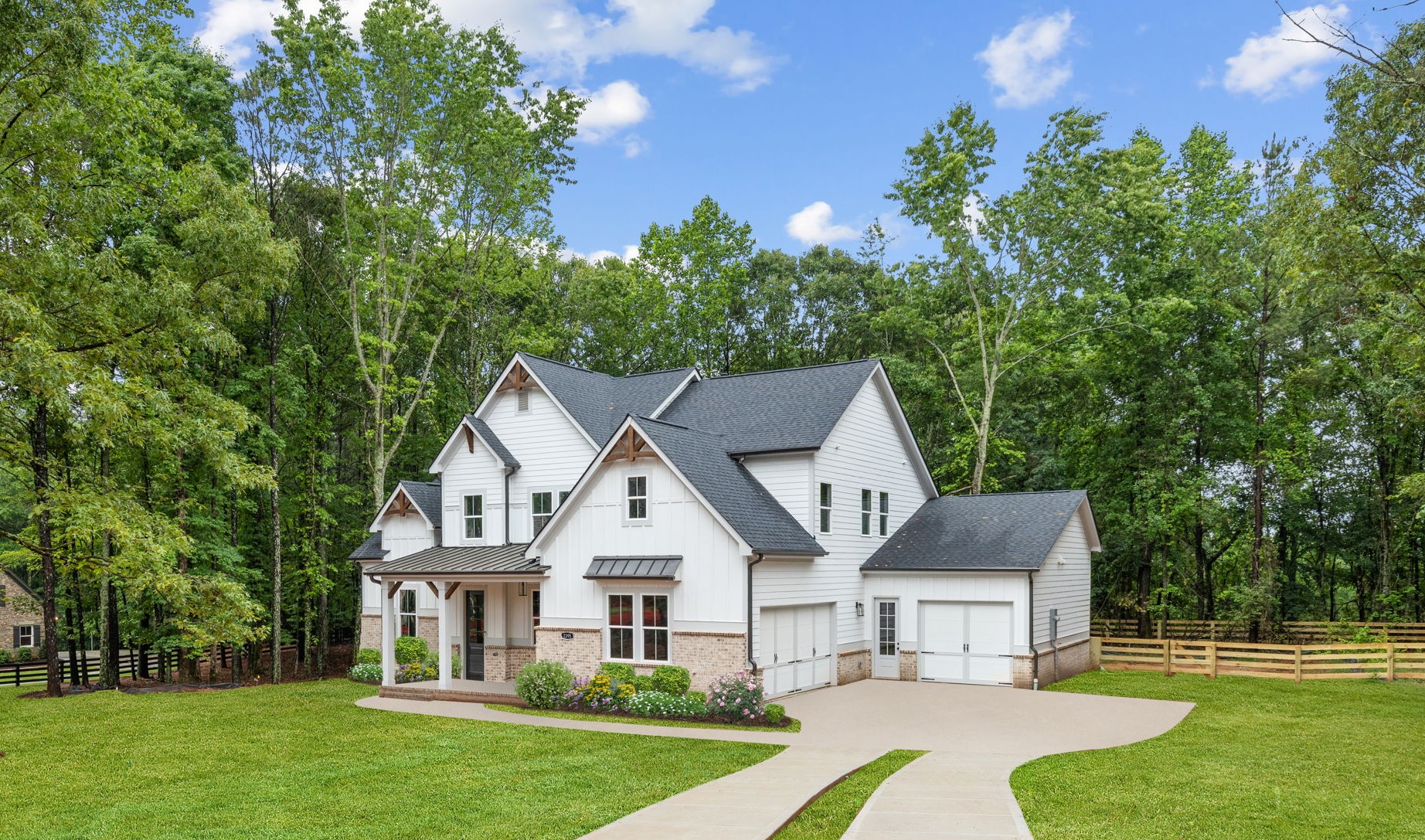
The Glade is also a boutique community of just four estate homes, each on a homesite of one acre or more, on Trammel Road just off Highway 20 in South Forsyth and minutes from GA 400.
The home available now at 2390 Glade Overlook is a Tamarack plan with five bedrooms, four-and-a-half baths, 3,712 square feet, 10-foot ceilings on both levels and owner’s and guest suites on the main level, priced at $1,250,000.
Learn more by visiting The Glade community page.
White Post on Lake Lanier in Gainesville: Homes Available from $1,050,000 to $1,288,500
White Post on Lake Lanier sits on Browns Bridge Road in Forsyth County near Port Royale Marina, and every homesite includes a dedicated deep water boat slip at the covered community dock.
Available homes offer four and five bedrooms with up to 3,777 square feet of living space, and select options such as a third-car garage, basement and main level primary suites.
View the White Post on Lake Lanier community page to learn more.
Frequently Asked Questions About Forsyth County Senior Tax Exemptions
At what age do I stop paying school taxes in Forsyth County, Georgia?
You stop paying school taxes on your primary residence in Forsyth County once you are 65 or older on January 1 and the Board of Assessors approves your L1 age 65 school tax exemption. The exemption covers school general and school bond taxes on the home you live in and the land with it, and it requires a separate application even if you already have a regular homestead exemption.
Is there an income limit for the Forsyth County age 65 school tax exemption?
The Forsyth County age 65 school tax exemption has no income limit, so any homeowner who is 65 or older on January 1 and claims the home as a primary residence can qualify. The separate double homestead exemption for homeowners 65 and older does carry an income limit of $40,000 in combined gross income for the applicant and spouse.
If only one spouse is 65, can we still get the Forsyth County senior school tax exemption?
A married couple can receive the Forsyth County senior school tax exemption when only one spouse is 65, provided that spouse is an owner on the deed and lives in the home as a primary residence as of January 1.
When can I claim the homestead exemption after buying a new home in Forsyth County?
You can claim the homestead exemption on a new home in Forsyth County for the first tax year in which you own and live in the home on January 1, and you must file by April 1 of that year. A closing in December 2026 qualifies for the 2027 tax year, while a closing in January 2027 qualifies beginning with the 2028 tax year.
Do I have to reapply for my senior exemption if I move to a different home in Forsyth County?
You must reapply for your senior exemption when you move to a different home in Forsyth County, because the county renews an exemption automatically only for the property where it was originally granted. The same requirement applies after any change to the deed.
Does the Forsyth County senior school tax exemption also eliminate county property taxes?
The Forsyth County senior school tax exemption eliminates only the school general and school bond portions of the bill, so county maintenance and operations and fire taxes still apply. Those county taxes are reduced by the regular $8,000 homestead exemption and the county floating homestead exemption, or by the $16,000 double homestead exemption for homeowners 65 and older with a combined gross income of $40,000 or less.
Does Georgia tax Social Security benefits?
Georgia does not tax Social Security benefits, and those benefits also do not count toward the state’s retirement income exclusion, which leaves the full exclusion available for pensions, IRA distributions and investment income.
How much retirement income can I exclude from Georgia income tax at age 65?
You can exclude up to $65,000 of retirement income from Georgia income tax for 2026 if you are 65 or older, and that amount rises to $70,000 per person beginning with the 2027 tax year. The exclusion applies separately to each spouse and only to income received in that spouse’s own name, including up to $5,000 of earned income.
What is Georgia’s state income tax rate for 2026?
Georgia’s state income tax rate for 2026 is a flat 4.99%, which applies to all filers after the standard deduction, dependent exemptions and any retirement income exclusion. State law schedules a reduction of 0.125 percentage point each year beginning in 2027 until the rate reaches 3.99%, but each step depends on Georgia meeting revenue conditions written into the law.
*This article is general information and is not tax or legal advice. Exemption rules, income limits and tax rates are set by state and local law and can change, so confirm eligibility with the Forsyth County Board of Assessors and a qualified tax professional before making decisions.